
/ RIB Candy Training & Development
Develop the RIB Candy capability you actually need
* Graphics are for illustrative purposes only and may differ from the actual software interface.
Learning RIB Candy is not always about doing another full course.
Sometimes you need structured training. Sometimes you are already using Candy but need help with a particular task. And sometimes the real challenge is applying what you have learned consistently on live construction work.
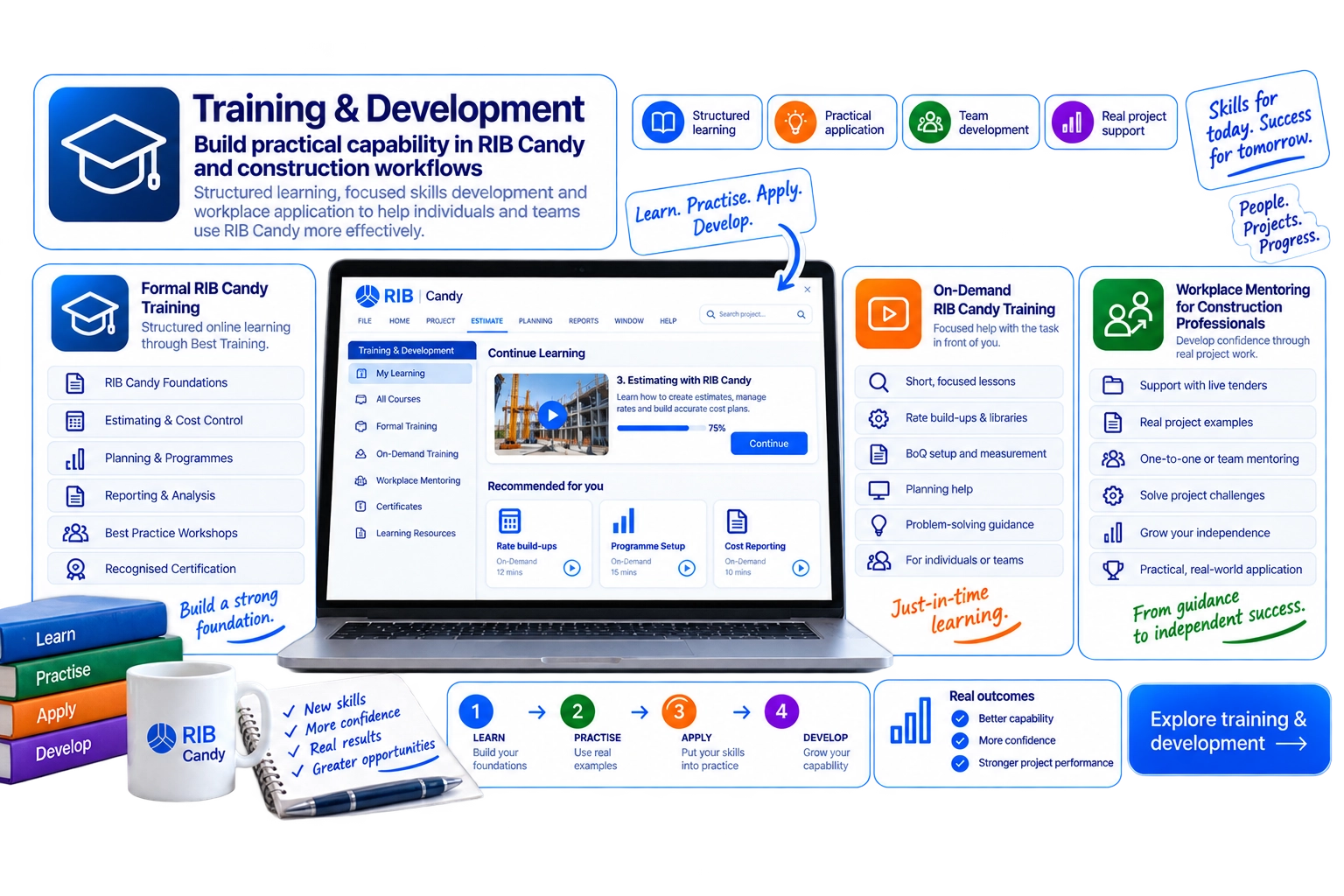
RIB Candy Assist provides three development routes to match those different needs:
- Formal RIB Candy training
- Focused on-demand training
- Workplace mentoring
The aim is practical capability — understanding not only where things are in the software, but how RIB Candy supports estimating, planning, commercial management and project control.
Which development route is right for you?
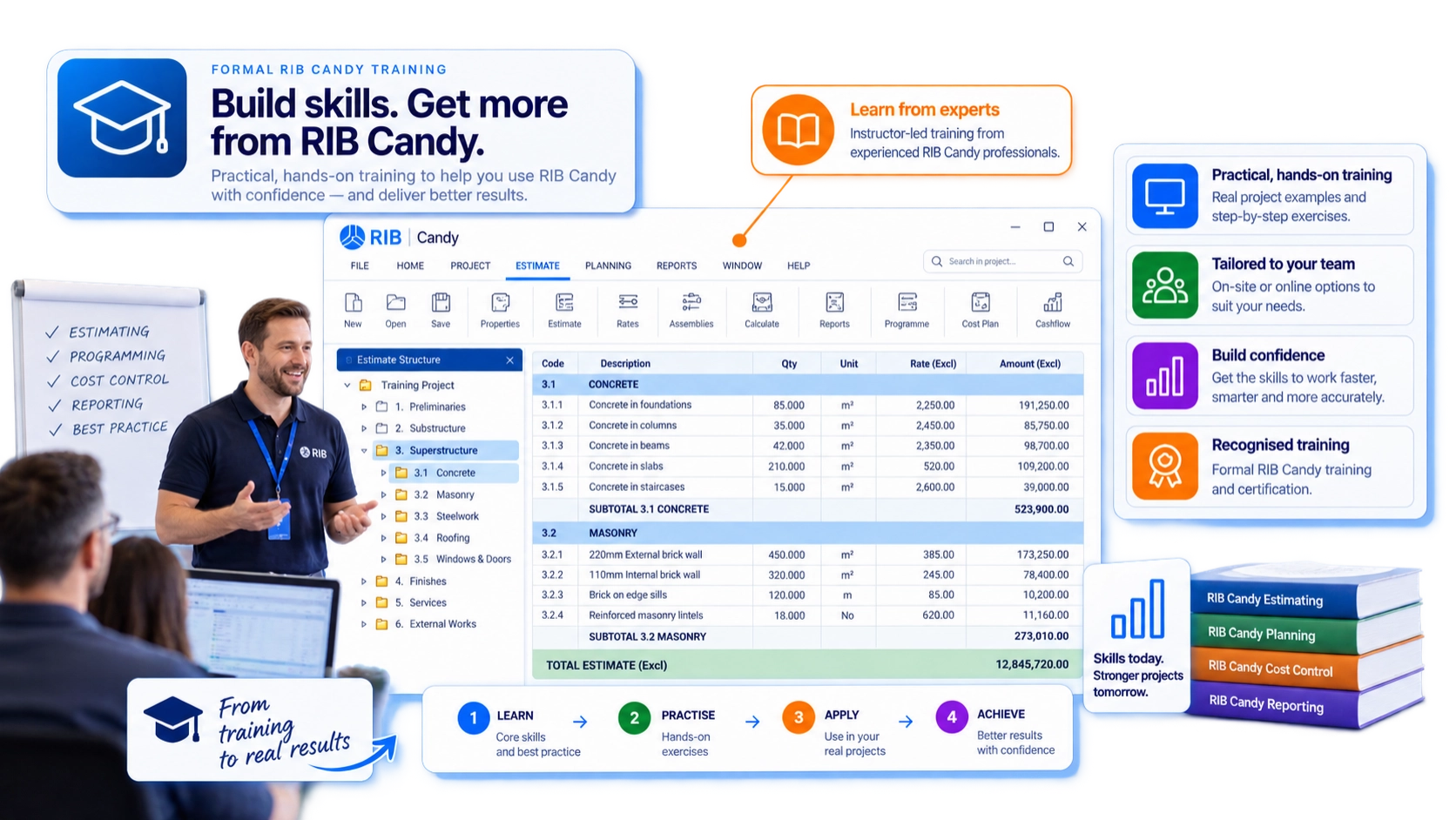
Formal RIB Candy Training
Structured learning through Best Training.
A formal training route for people who want to build a broader understanding of RIB Candy across estimating, planning and related construction workflows. It is a good starting point for newer users or team members who need a structured foundation before applying the software in day-to-day work.
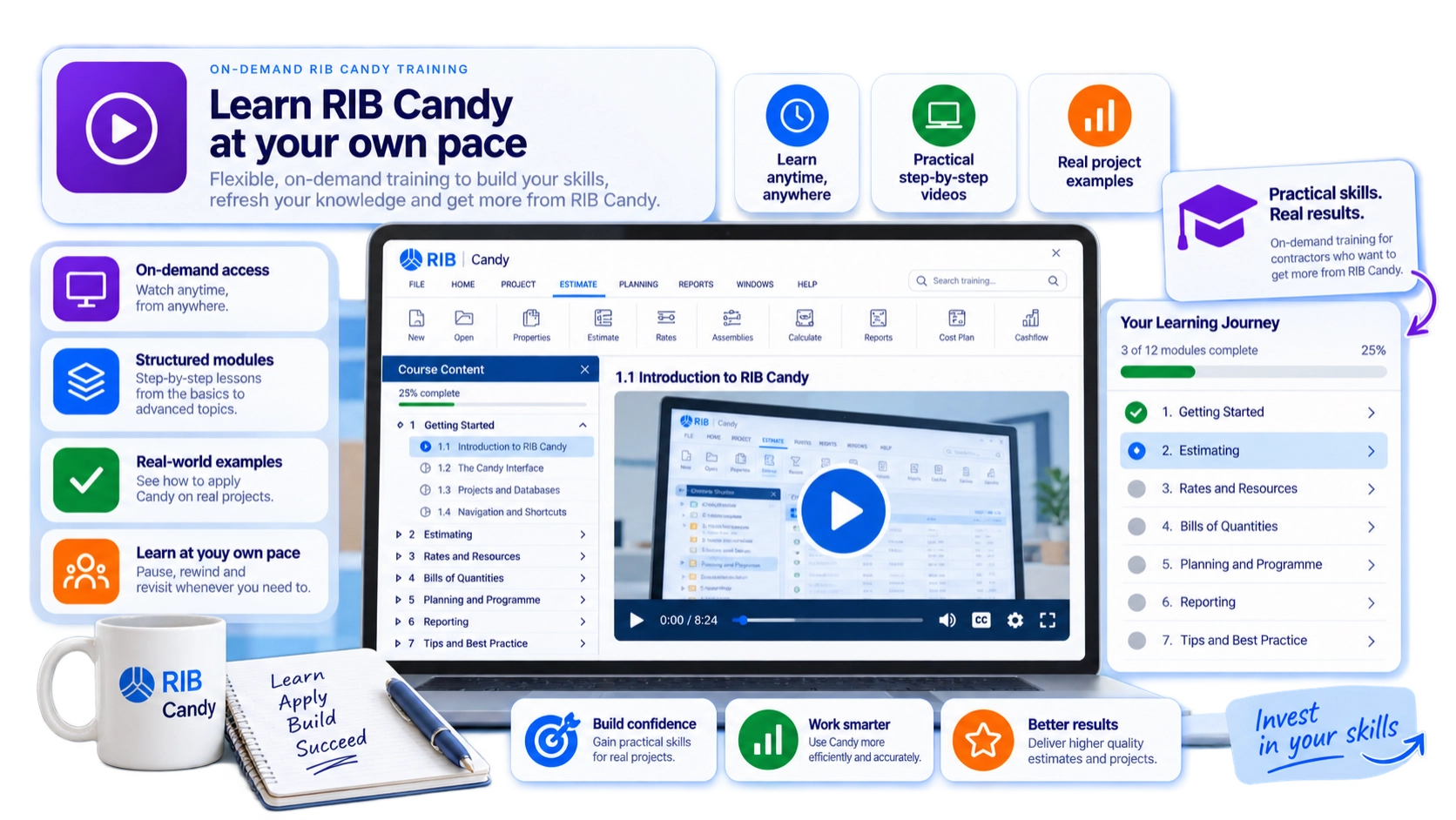
On-Demand RIB Candy Training
Focused training around a specific task or skill.
On-demand training is designed for people who already know what they need help with. Sessions can focus on a particular RIB Candy process, workflow or team requirement, such as rate build-ups, BoQ setup, planning, forecasting or tender finalisation.
Workplace Mentoring
Practical development through real work.
Workplace mentoring provides ongoing guidance while you apply what you are learning to live construction situations. This can include tenders, programmes, cost reports and other project work, with the focus on developing stronger judgement, practical ability and increasing independence over time.
Training, mentoring or consulting?
There is an important difference.
Training
We show you how it works.
Use training when you need to understand a method, function or RIB Candy process.
Mentoring
We do the specialist work or solve the problem for you.
If the immediate priority is getting a tender priced, setting up a contract, solving a project-control problem or implementing a process, Assistance & Consulting may be the better route.
Consulting
We do the specialist work or solve the problem for you.
If the immediate priority is getting a tender priced, setting up a contract, solving a project-control problem or implementing a process, Assistance & Consulting may be the better route.
Practical RIB Candy learning for construction work
RIB Candy should not be learned as a collection of disconnected software functions.
The value comes from understanding the construction work behind those functions.
That may mean learning how to:
- Set up and structure a Bill of Quantities for pricing
- Build rates from labour, plant, materials and other resources
- Develop and use rate-build-up libraries
- Deal with indirect costs and preliminary and general items
- Prepare and review tender pricing
- Build a construction programme
- Link the BoQ and programme
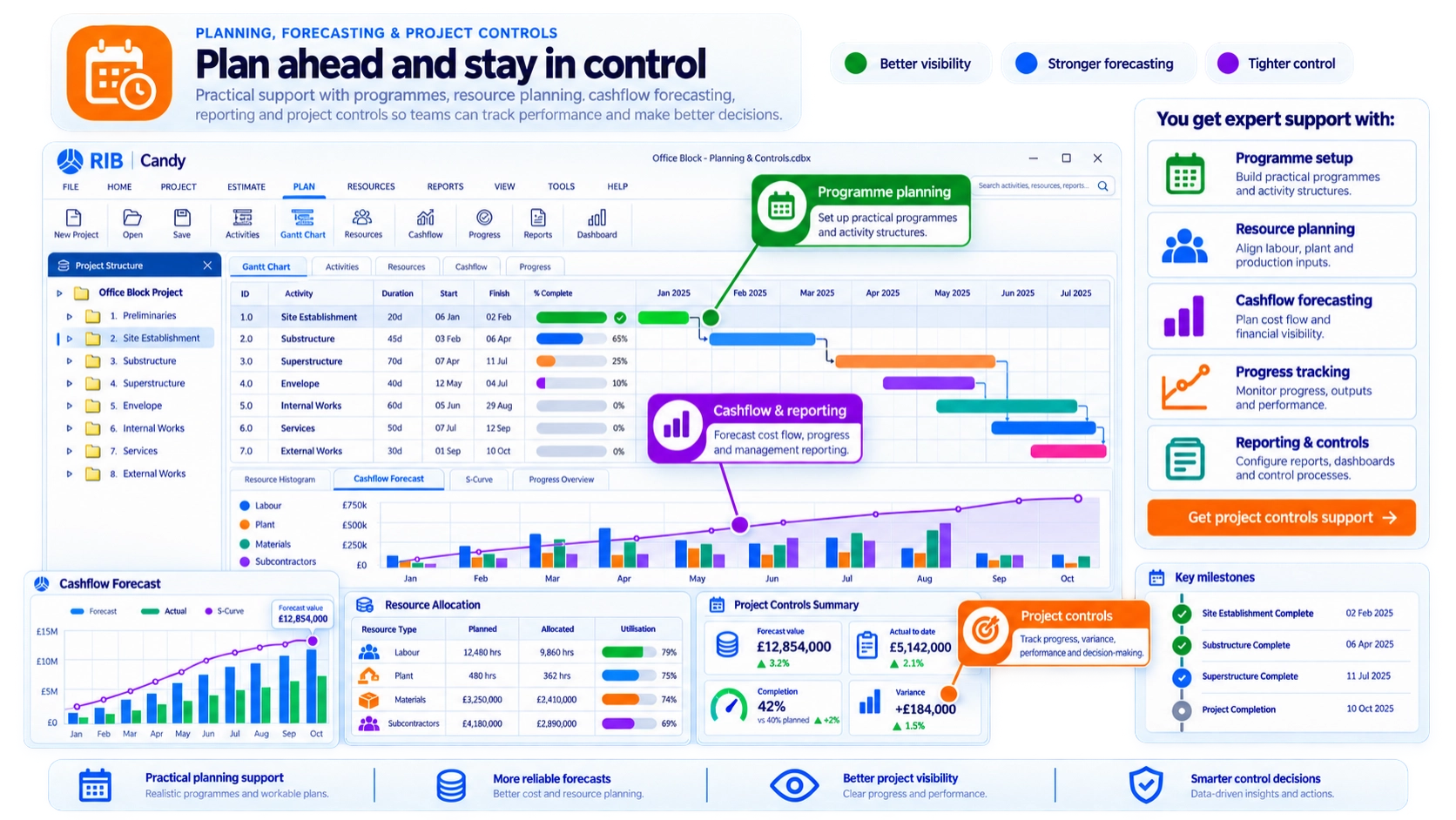
- Use estimating and planning information for forecasting and project control
The software supports the process. Construction, estimating and commercial judgement still matter.
Learning for individuals and teams
An individual estimator may need help building more defensible rates.
A planner may need to understand how the programme connects with resources and cost.
A contractor may need several people to work according to the same process so that estimating, planning and commercial information does not live in separate silos.
The right development route depends on where the gap is.
We can help identify whether formal training, focused on-demand training or workplace mentoring is the most sensible next step.
Not sure where to start?
Tell us what you or your team are trying to do, what you already know and where the current process is getting stuck.
We can help point you towards the right development route.
Frequently asked questions
What is workplace mentoring?
Workplace mentoring is structured development that happens alongside real construction work.
Rather than only teaching a subject, the mentor helps the participant apply knowledge, work through problems, develop judgement and become progressively more independent.
How is mentoring different from training?
Training teaches a method, subject or process.
Mentoring supports the participant while they apply that learning to real work over time.
Training might explain how to prepare a construction programme. Mentoring might then help someone work through the decisions and problems they encounter while preparing and managing an actual programme.
How is mentoring different from consulting?
During consulting, the specialist may complete the work or solve the problem for the client.
During mentoring, the participant remains responsible for learning and doing the work, with guidance and review from the mentor.
The objective is development, not replacing the participant.
Who can benefit from construction workplace mentoring?
Mentoring can support:
- Emerging and established contractors
- Estimators
- Quantity surveyors
- Planners
- Site agents and construction managers
- Contracts managers
- Contractor owners
- Young construction professionals
- Public-sector construction personnel
The programme should be built around the person’s actual responsibilities and development needs.
What areas can mentoring cover?
Mentoring can extend across several areas of construction capability, including:
Technical: estimating, construction methods, planning, procurement, productivity, plant and resources.
Commercial: budgets, cost reports, valuations, variations, subcontract management, forecasting and final accounts.
Contractual: notices, claims, extensions of time, payment provisions, records and dispute avoidance.
Management: communication, reporting, decision-making, leadership, delegation and risk.
Systems: RIB Candy, BuildSmart, Excel, planning tools and document-control processes where relevant.
Is the mentoring only about RIB Candy?
No.
RIB Candy can form an important part of the mentoring where it is relevant to the participant’s role, but the broader objective is practical construction capability.
The development may also cover commercial, contractual, management and other systems-related skills.
Can mentoring use a live project?
Yes. Project-based learning is an important part of the approach.
Development may use real situations such as:
- A current tender
- Construction programme
- Monthly cost report
- Subcontractor quotation
- Variation
- Extension-of-time issue
- Payment certificate
- Procurement schedule
- Live site problem
This allows the participant to develop skills while dealing with the work they actually need to perform.
How does a workplace mentoring programme start?
The process normally begins by understanding the participant’s role, current capability and responsibilities.
From there, development gaps can be identified and a practical development plan established.
Regular mentoring, workplace application and progress reviews can then be structured around those priorities.
How long does workplace mentoring take?
The duration depends on the participant, the competencies being developed and the work available for practical application.
Mentoring is intended as ongoing development rather than a once-off session, so it will normally take place over a period of time rather than being completed in a single workshop.
What is expected from the employer?
Workplace mentoring works best when the employer gives the participant opportunities to apply what they are learning.
That means access to relevant work, appropriate responsibility, time to participate and management support for the development process.
Mentoring cannot develop workplace competence if the participant never gets the opportunity to do the work.
Does the mentor do the participant's work for them?
No.
The mentor may demonstrate, explain, review and guide, but the purpose is for the participant to develop their own capability.
Where a business needs specialist work completed on its behalf, Assistance & Consulting is the more appropriate service.
Can mentoring help reduce reliance on one experienced employee?
It can help with knowledge transfer and capability development across a wider team.
Where one estimator, planner or commercial employee holds most of the practical knowledge, structured mentoring can help other people develop the skills needed to take on more responsibility.
Does workplace mentoring include assessments or certification?
Assessment, reporting and any formal certificate arrangements will depend on the mentoring programme agreed.
These elements should be confirmed when the programme is scoped rather than assumed for every mentoring engagement.