
/ Workplace Mentoring for Construction Professionals
Develop practical capability through real work
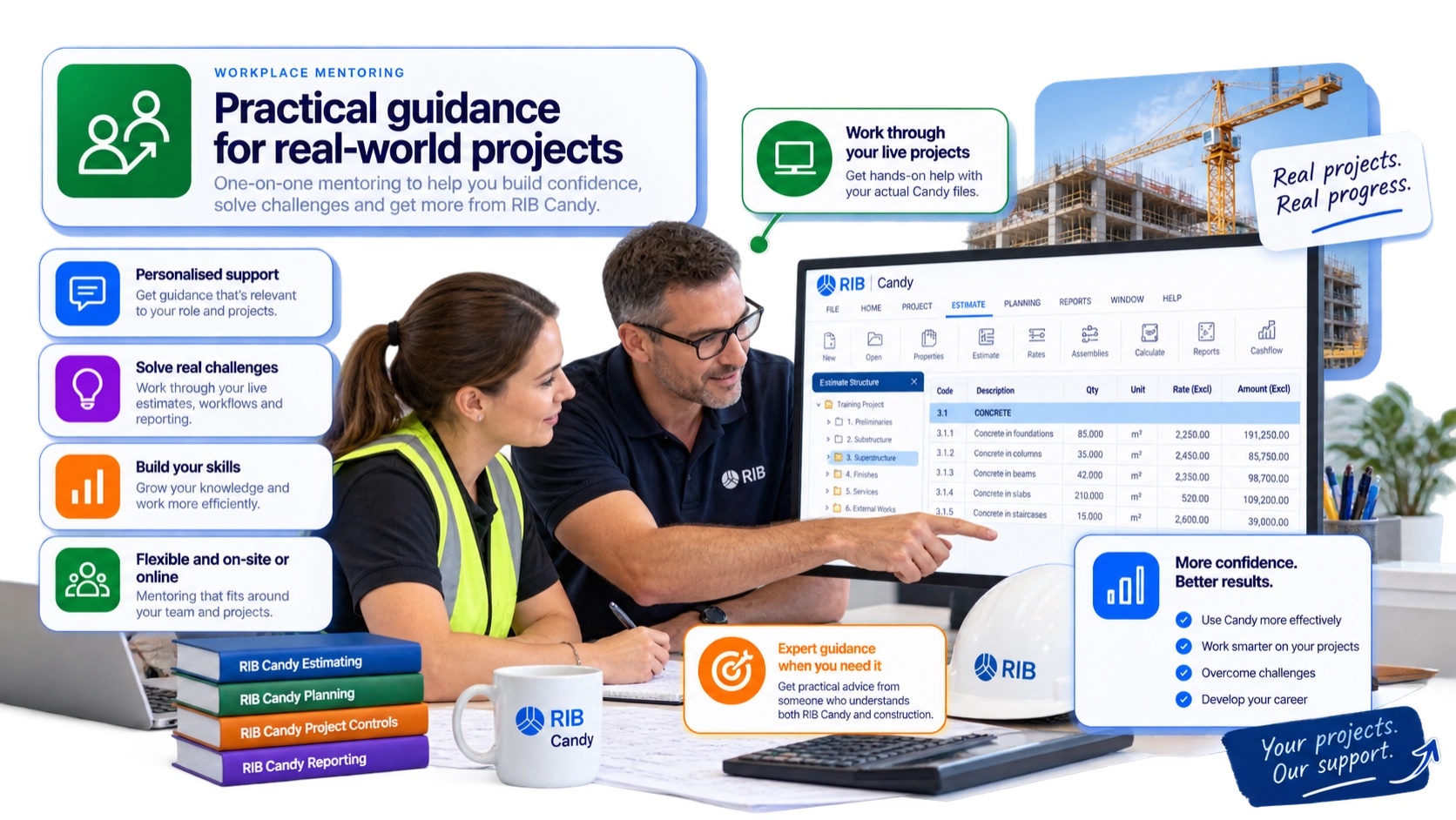
* Graphics are for illustrative purposes only and may differ from the actual software interface.
Training can explain how something should be done.
The difficult part often starts when you have to apply it to an actual tender, programme, cost report or project problem.
Workplace mentoring helps bridge that gap.
We work alongside construction professionals while they apply their knowledge to real work, develop judgement and progressively become more independent.
The mentor’s role is not simply to solve the problem for the participant. It is to help them understand how to deal with the problem themselves.
Who is workplace mentoring for?
Mentoring can support individuals, teams and contracting organisations at different stages of development.
This may include:
- Emerging contractors
- Established contractors
- Site agents and construction managers
- Quantity surveyors
- Estimators
- Planners
- Contracts managers
- Young construction professionals
- Contractor owners
- Public-sector construction personnel
The development plan should reflect the person’s role, current capability and the work they are expected to perform.
What can mentoring help develop?
Construction competence is rarely one isolated skill.
A person may understand estimating but struggle with commercial reporting. Another may understand site operations but need stronger contractual knowledge. A company may rely too heavily on one experienced employee because knowledge has not been transferred to the rest of the team.
Mentoring can therefore cover several development areas.
Technical capability
This may include:
- Estimating
- Construction methods
- Planning
- Procurement
- Productivity
- Quality
- Plant management
- Resource management
Commercial capability
Development may include:
- Budgets
- Cost reports
- Cash flow
- Valuations
- Variations
- Subcontract management
- Forecasting
- Final accounts
Contractual capability
This can include practical understanding of:
- Notices
- Instructions
- Claims
- Extensions of time
- Payment provisions
- Project records
- Dispute avoidance
Management capability
Mentoring can also address:
- Delegation
- Communication
- Meetings
- Reporting
- Decision-making
- Leadership
- Risk management
Systems and working methods
Depending on the participant’s role, this may include:
- Excel
- Estimating systems
- Planning software
- Document control
- RIB Candy
- BuildSmart
Software is part of the working system — not a substitute for construction and commercial judgement.
Mentoring is built around real work
The strongest learning often comes from dealing with something that genuinely needs to be done. Instead of manufacturing classroom exercises for every situation, the development can happen around the work the participant is already responsible for.
Practical mentoring activities may therefore use a:
- Current tender
- Construction programme
- Monthly cost report
- Subcontractor quotation
- Variation
- Extension-of-time issue
- Payment certificate
- Procurement schedule
- Live site or project problem
How workplace mentoring can work
A mentoring programme can follow a structured development process.
Mentoring is not outsourced consulting
This distinction matters.
When consulting, the specialist may carry out the work, establish the system or solve an immediate project problem. During mentoring, the participant remains involved in doing the work. The mentor guides the approach, asks questions, explains the reasoning, reviews the work and helps the participant improve.
- Training: We show you how it works.
- Mentoring: We work alongside you while you learn to do it yourself.
- Consulting: We do the specialist work or solve the problem for you.
If the organisation currently needs someone to carry out the specialist work, our Assistance & Consulting services may be the more appropriate starting point.
Mentoring can support organisational capability too
For an employer, mentoring is not only about developing one person’s CV.
It can help reduce reliance on isolated pockets of knowledge and develop stronger capability inside the business.
That is particularly important when a company depends heavily on one estimator, planner or commercial employee who understands a system or process that nobody else can comfortably take over.
Developing junior and intermediate people alongside experienced staff can help make knowledge part of the organisation rather than something that walks out of the door when one person leaves.
Discuss a mentoring need
Tell us about the person or team, the work they are responsible for and the capability you want to develop.
We can then discuss whether workplace mentoring is suitable and what a practical development structure could look like.